Loss of Control in-flight (LOC-I) is an ICAO Global High-Risk Category of occurrence (G-HRC). G-HRC’s are identified in ICAO’s Global Aviation Safety Plan as a global safety priority that should be addressed to mitigate the risk of fatalities.
The 2025 Flight Safety Foundation Safety Report highlighted that there were 4 LOC-I Corporate Jet accidents as per the ASN database, and all 4 of them were fatal accidents. As per the report, in the 2020-2024 period, corporate jets were involved in an average of 4.4 LOC-I accidents per year. The report also highlighted the increase of LOC-I’s in 2025 for commercial airliners, this was previously trending downwards, however 2025 saw 6 LOC-I’s , five were fatal accidents.
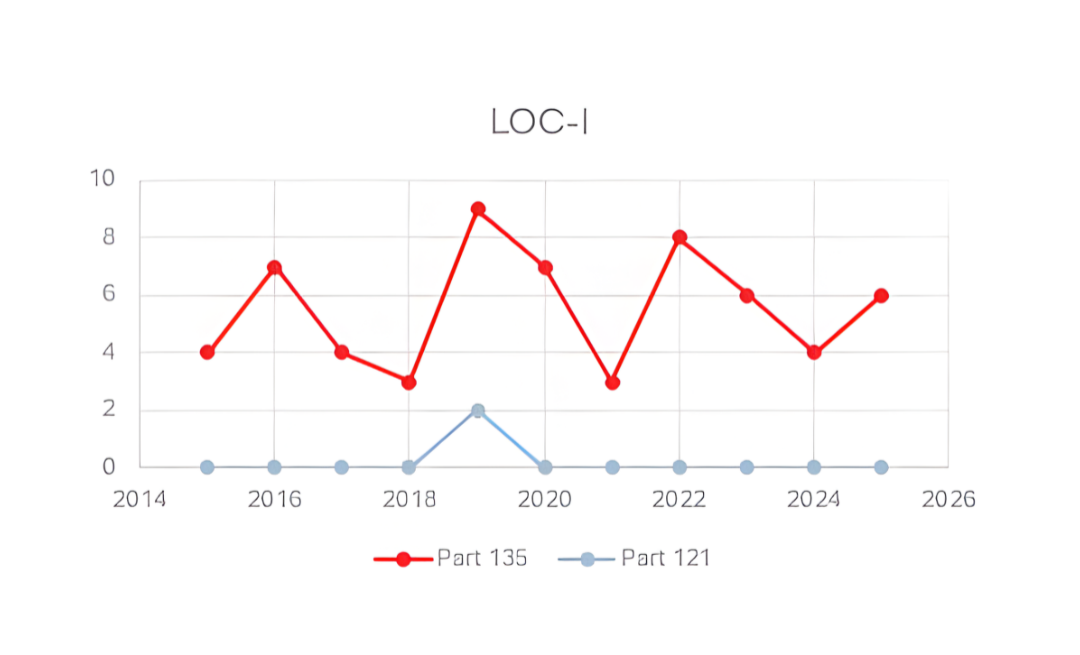
A review of NTSB’s data set for accidents and serious incidents in the United States for Part 135 and Part 121 operators shows the following trend for LOC-I. The data shown in the chart below indicates that LOC-I is more prevalent in Part 135 Operations than in Part 121 Operations.
Below is a breakdown of causal factors for both Part 135 and Part 121 Operations.
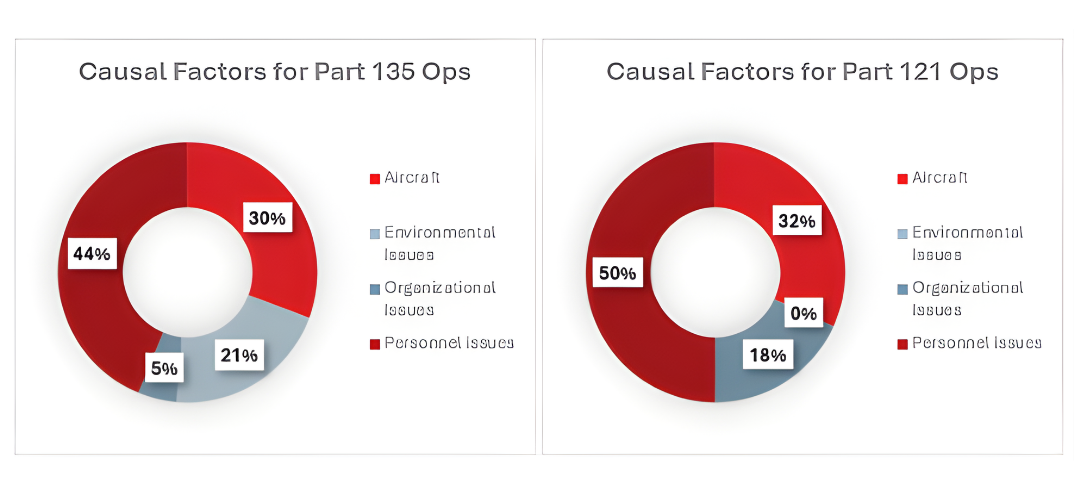
A key point to note is that there were zero LOC-I incidents/accidents caused by Environmental Issues for Part 121 operations in the last decade. Whereas, for Part 135 operations, Environmental Issues are the third leading cause of LOC-I incidents/accidents, with Personnel Issues being the leading cause. Environmental Issues include the operating environment, physical environment, weather conditions, and the task environment. Personnel Issues include Action/Decision, Experience/Knowledge, Physical, Psychological, and Task performance.
Part 135 operations cover on-demand charter, air taxi, air ambulance, sightseeing flights, and cargo transport, often in challenging environments (e.g., remote areas, varied weather conditions, smaller airports, etc.). This increases risk exposure to situations that could lead to LOC-I. Additionally, Part 121 operations require two pilots to operate a flight, whereas Part 135 operations have dual-pilot and single-pilot operations, depending on the aircraft and type of operation. In a single-pilot operation, the pilot has a higher workload and less redundancy to manage complex situations or recover from upsets.
Part 135 operations can be more complex and would benefit from a systematic approach to managing operational risk, so that hazards can be proactively identified and managed. This approach has benefited Part 121 operations through the implementation of a Safety Management System (SMS), as SMS is designed to be integrated with existing operational systems, not as a separate entity.
JumpseatSMS helps operators proactively analyze operational hazards collected as safety data, to assist with preventing and predicting high-risk events like loss of control, thus enabling the operator to make data-driven safety decisions.
Safety Round Table
How can an operator’s SMS capture “near upset” events that didn’t result in an accident but did trigger a startle response?

JumpseatSMS Feature Updates
We have some exciting updates for the SMS Safety Promotion pillar coming in Q2 2026!


Copyright (C) 2025 mba Aviation. All rights reserved.

No responses yet